
During my career I have seen several instances, where safety and reliability are not properly understood and often interchanged with each other. Sometimes on a concept level or vehicle function design level if the engineer is not experienced with ISO26262 (like non-EU OEM for example) but knows the basics of the ASIL concept tends to classify all of the supplier requirements on the highest ASIL, just to be sure that the vehicle would be safe. This is how I met reliability requirements mistaken to safety requirement. To clean up the confusion I prepared a very simple example to demonstrate how these two concepts are entirely different.
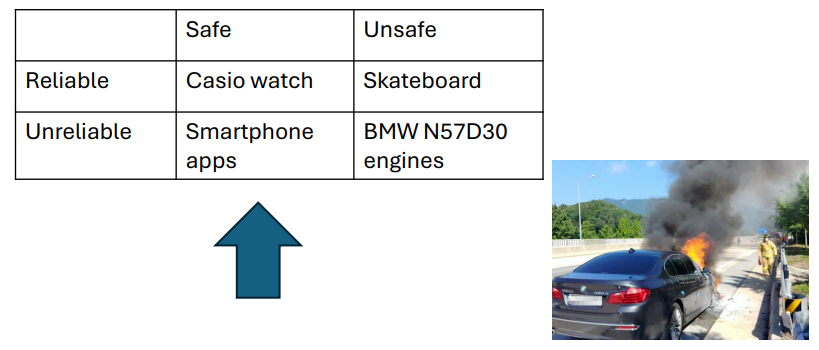
- Let’s look at the picture above. A safe and reliable product is a Casio watch. It works all the time and poses no danger on the user whatsoever.
- An unsafe and reliable product is for example a skateboard. It’s a simple design with reliable parts, and we can’t really think of a skateboard that is non-functioning for some reason other than being broken or destroyed. However, it is a very dangerous vehicle: anyone without the proper training AND protective gear is subject to risk of physical harm.
- A safe but unreliable product is basically any smartphone app. An app can not possibly malfunction in such a way that could harm the user. But they are usually very unreliable, they can freeze, lag and crash any time.
- An unsafe and unreliable product is the BMW N57D30 engine, that has a tendency of sucking in the engine oil through the bearings of the turbocharger and thus making it impossible to turn it off by cutting the fuel supply. This usually ends in the fire of the engine and the whole vehicle.
The main takeaway from the above is, that a product can be safe without being reliable.
Leave a Reply