
FMEA, Failure Mode and Effect Analysis originates from the 1940s and still today it’s widely used in all branches of product design and development. Many standards require an FMEA analysis to help eliminating potential hazards of a system/component or process. FMEA is basically a structured answer to the question: “What could go wrong?”. It is important that FMEA is NOT a design tool, it aims to analyse something that is at the end of the design lifecycle, and it considers only one failure a time.
I.
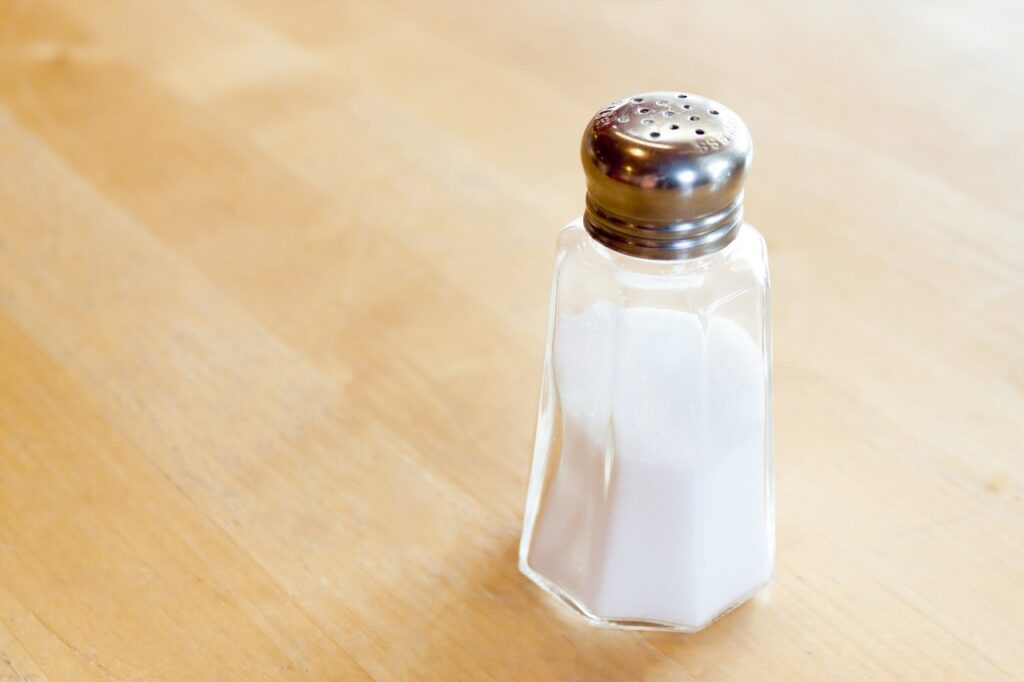
Let’s say that our company plans to release a saltshaker with a metal lid, which we have to analyze to ensure product safety and quality.
In the first step let’s list what could go wrong:
- The holes get blocked, and the salt won’t come out or only a few small pieces will fall through with each shake
- The cap will corrode and contaminate the salt
- When the salt gets stuck at the bottom due to humidity and the user smashes it to the table, the glass can break and cuts the user’s hand
- …
Here we can see the first catch of FMEA: to find sensible failure modes. For example, a lightning striking the cap of the saltshaker and melting it thus closing the holes is technically a failure mode, but no one would consider this during the design. Therefore, it is important to include someone in the analysis with domain experience to advise which faults are sensible for consideration.
II.
As we have 3 failure modes let’s have a deeper look at them and see what is the most severe. Using common sense anyone would say that failure nr. 3 is the most severe possibly seeing the bleeding hand on front of our eyes. But FMEA is smarter than common sense: it uses 3 aspects to rate the severity of a failure: severity, probability and controllability. Let’s see an example for each:
- Severity: the magnitude of the harm it could cause(to people, infrastructure, business, legal matters etc.):
- High severity: a phone battery exploding
- Low severity: camera flash malfunction
- Probability/Exposure: how likely is it that the failure will occur during the design lifetime
- High probability: discoloration of a shoe sole
- Low probability: discoloration of a glass bottle
- Controllability: if we discover the problem occurring can we intervene (move the people away from the threat)
- High controllability: incorrect set temperature of an air conditioner
- Low controllability: sudden explosion of a car tire
It is very important that when quantifying the above aspects, the scale should always spread from most favorable (1) to least favorable (10). The most common is the 1-10 but other scales are also allowed, provided that same scale is used for all of the 3 aspects!
Let’s grade now our failures from above on a 10-level scale:
- The holes get blocked, and the salt won’t come out or only a few small pieces will fall through with each shake
- Severity: 3, since it only effects the product usability
- Probability: it will most probably happen during the lifetime of the saltshaker, so we can grade it as an 8
- Controllability: 1, since the user can just buy a more fine-grained salt
- The cap will corrode and contaminate the salt:
- Severity: 7, since it’s not going to be lethal, but could pose a high health risk on prolonged use
- Probability: we are talking about a metal lid, it’s very probable that normal humidity and the corrosive nature of salt will corrode the lid during the product lifetime, so it’s 8
- Controllability: 5
- When the salt gets stuck at the bottom due to humidity and the user smashes it to the table, the glass can break and cut the user’s hand
- Severity: 8, since it’s not lethal but poses a high risk of human injury
- Probability: the thick glass can not break when hit against a usual table with human force. It most likely breaks when hit against an uneven concrete/stone surface. We can state that it’s very unlikely that the glass breaks during expected use: 2
- Controllability: thin glass breaks suddenly, but our saltshaker is thick, so it’ll chip first. Also, we can control the force and surface we use. Let’s grade it to a 4.
It’s apparent that the gradings are not fully objective. There might be scales with examples and explanations for each grade, but overall, this is a subjective grading where FMEA shows one of its weaknesses: without domain experienced members in the analysis team, it’s very easy to over/underestimate the gradings.
III.
Now as we graded our failures let’s calculate the RPN aka. the Risk Priority Number. This dimensionless number will guide us to weight the risks of out failures. The RPN is the product of the grades of the three aspects of each failure mode:
- 3*8*1 = 24
- 7*8*5 = 280
- 8*2*4 = 64
We can see from the above results, that the highest risk is contaminating the salt, and not cutting the user with broken glass.
IV.
Now that we have a single number for each failure, it’s time to decide which are the ones we need to focus on aka. define corrective actions. Deciding this is the consideration of the team or the company. Sometimes high severity failures are always considered regardless of the RPN, sometimes the top few RPNs are focused on and sometimes there is a limit, for example RPN 250, which is subject to corrective actions. These actions usually aim to decrease the number of one aspect. Let’s see now some examples for corrective actions on our highest RPN, failure nr.2:
- Replace the cap with plastic
- Apply protective layer on the cap
- Do not sell the product in high humidity areas
- Etc.
What is left now is to decide on the corrective action(s) and re-evaluate the RPN value of the fault ensuring that the new RPN will stat under our limit.
Leave a Reply